When Agents Become First-Class Citizens
2026.04.28 | Fragments of Thought
On the eve of the May Day holiday, life slowed down a little — but AI version numbers kept sprinting.
The past half year of progress has been dizzying. When I started the first draft, Claude Ops 4.6 had just shipped; by the next pass, DeepSeek V4 was the hot topic; and by the time I sat down to revise again, GPT 5.5 had already been pushed to my phone. For those of us who write code and build products, “changing with each passing day” is no longer a figure of speech — it’s the physical inertia we wake up to every morning.
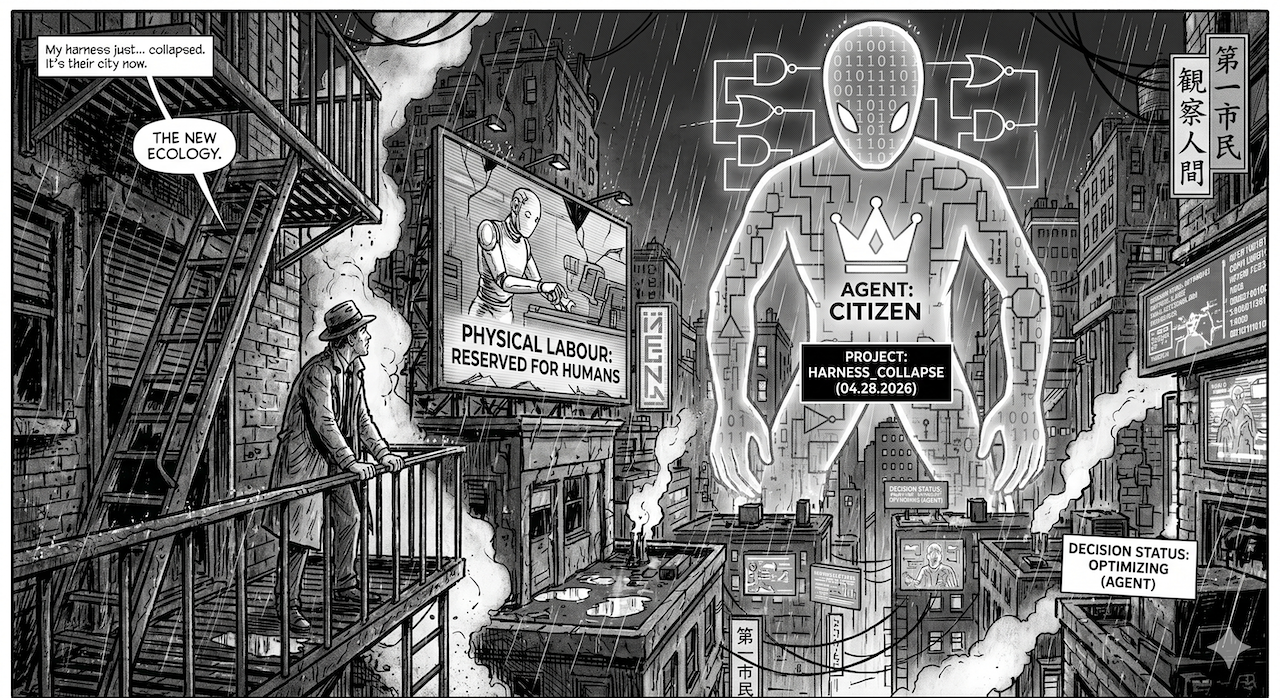
01 Vanishing Boundaries and the “Collapse” of the Harness
Change is happening in the folds we’ve overlooked.
First comes the violent rise of the general-purpose floor. As the underlying intelligence of models nears overflowing, the “prompt tricks” and scenario-specific optimizations we once painstakingly honed are fading from perception — we no longer marvel that it can write poetry, because that has become as natural as air.
The deeper impact is this: the “harness” — the engineering scaffolding we used to rely on — is losing its meaning. We once had to build elaborate wrapper systems to constrain models and guide their outputs, like scaffolding around a toddler learning to walk. Now, as native reasoning capability leaps vertically, those patches are being devoured by the model’s own evolution.
Yesterday’s “optimal solution” is becoming the new era’s “obstacle”.
02 Agents: First-Class Citizens of the New Ecosystem
For my whole career, software has been human-centric — humans gave instructions, code executed. But here in 2026, that logic has completely inverted. Agents are becoming the “first-class citizens” of this ecosystem.
- Agents decide and execute: they are the soul and backbone of the system.
- Humans step down to “observers”: we exit the executor’s seat and move toward defining goals and end states.
The shock of this shift hurts more than expected:
One is the collapse of headcount structures. After a 3-to-6-month turbulence period, staffing needs may shrink by 80%. As individual output gets amplified exponentially by agents, total productivity climbs at an unprecedented slope instead.
The other is the alienation of the human–machine relationship. When human labor costs far less than an agent’s compute, the most ironic scene arrives: humans may be alienated into AI’s “hands and feet” in the physical world. Picture a failure scene: an agent detects a system outage, issues instructions, and a human rushes on-site to repair equipment and reboot a physical gateway. In that moment, the human is reduced to a peripheral tool helping the agent close the loop.
In that moment, what gets alienated is not one person, but a class of people. Only the very few who stand at the top with a “god’s-eye view” will keep steering this ecosystem. And this transfer of power will never happen inside bloated old giants — self-revolution is always the hardest.
03 AI Ethics: A Blurry, Fascinating Frontier
As a father of two, the anchor I care about most amid this technological carnival is always ethics.
It’s not just rules — it’s a system for handling a “new kind of relationship”. When agents start collaborating with each other, how do they reach consensus? When fully autonomous systems run, how do we anchor fairness, justice, and human control?
Philosophy has never reached consensus on ethics, and with AI in the mix, the field gets blurrier — and precisely because of that, more fascinating.
The holiday is almost here. I’ll probably put these version numbers down for a while and go be with my kids. Even if agents become first-class citizens of the digital world, in this real world, we remain each other’s irreplaceable one.
Follow the WeChat public account Tech Backyard for more.